If you are new to Asian fashion, it’s incredibly easy to confuse traditional Chinese, Japanese, and Korean clothing. To an untrained eye, they are all just “flowing, beautiful robes.” However, each garment has a distinct history, cultural significance, and structural design.
Whether you are looking to buy your first piece of traditional clothing or just want to understand the cultural roots of your favorite K-drama or anime, here is a beginner-friendly breakdown of the differences between Chinese Hanfu, Japanese Kimono, and Korean Hanbok.
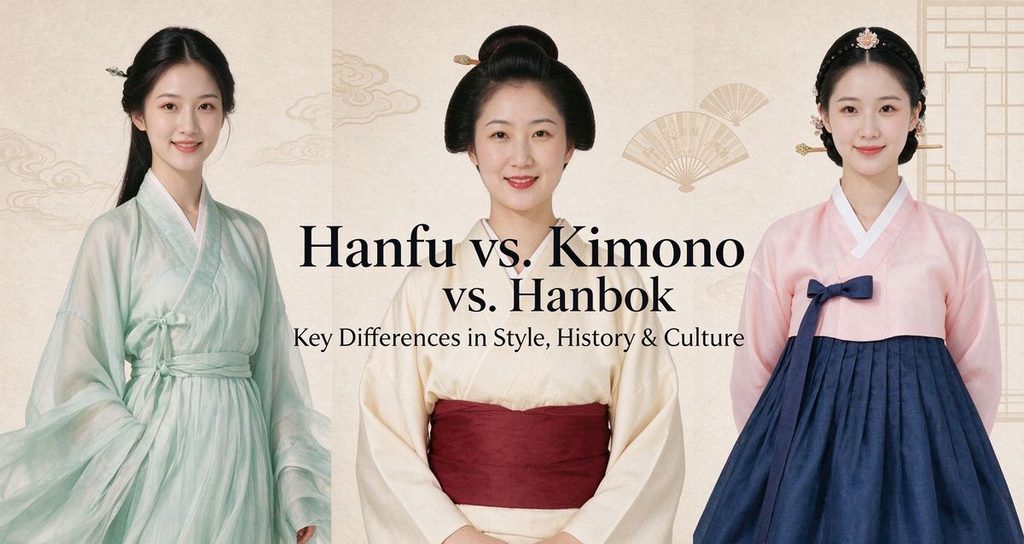
1. Chinese Hanfu (汉服): The Flowing Elegance
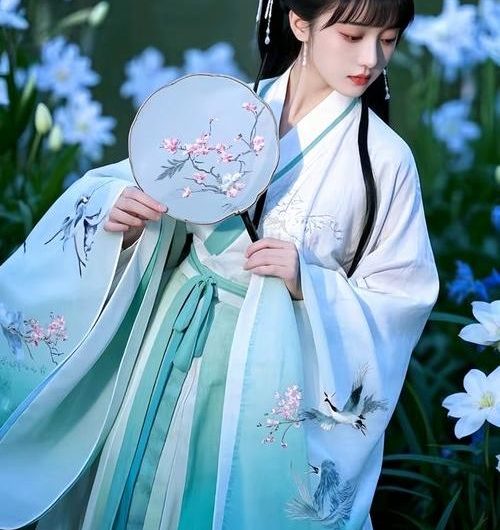
What it is: Hanfu is the traditional clothing of the Han Chinese people, which was worn for thousands of years before the Qing Dynasty.
Key Characteristics:
- The Collar: The most defining feature of Hanfu is the “Jiao Ling” (Crossed Collar). The left side of the garment wraps over the right side (Y-shaped collar).
- The Sleeves: Hanfu sleeves are often very wide and flowing, especially in formal styles.
- The Waist: It is usually tied with a sash or a belt, either at the natural waist or high on the chest.
- Layers: Hanfu is often worn in layers. A common setup is an inner top, an outer jacket (like a Beizi), and a flowing skirt (like a Ma Mian Qun).
The Vibe: It emphasizes a free, airy, and ethereal aesthetic. It is designed to flow with the body’s movement.
(Curious about starting your Hanfu journey? Read our [Beginner’s Guide to Choosing Your First Hanfu] )
2. Japanese Kimono (着物): The Structured Canvas
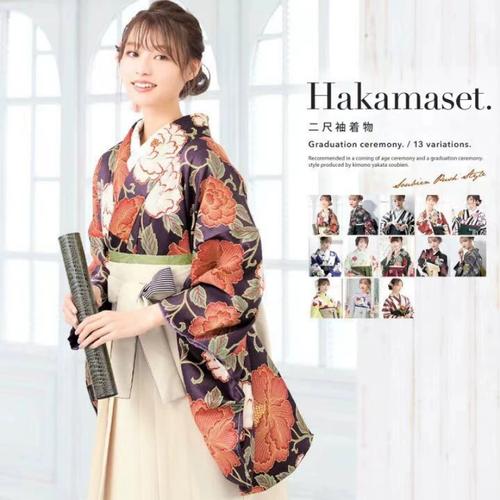
What it is: The Kimono is the iconic traditional garment of Japan, evolving heavily during the Heian period.
Key Characteristics:
- The Collar: Like Hanfu, the Kimono also has a crossed collar (left over right).
- The Shape: Unlike the flowy Hanfu, the Kimono is typically a straight-seam garment. It is made of long, straight pieces of fabric, meaning the garment looks like a “T” shape when laid flat.
- The Obi (Belt): This is the biggest giveaway. The Kimono is secured by a very wide, stiff sash called an Obi, which is tied at the back. It can be incredibly thick and restrictive.
- The Sleeves: Kimono sleeves are attached to the body, unlike Hanfu’s wide-open sleeves, and they hang down like pockets.
The Vibe: Kimonos are highly structured, formal, and designed to create a straight, cylindrical silhouette, hiding the natural curves of the body.
3. Korean Hanbok (한복): The Voluminous Silhouette
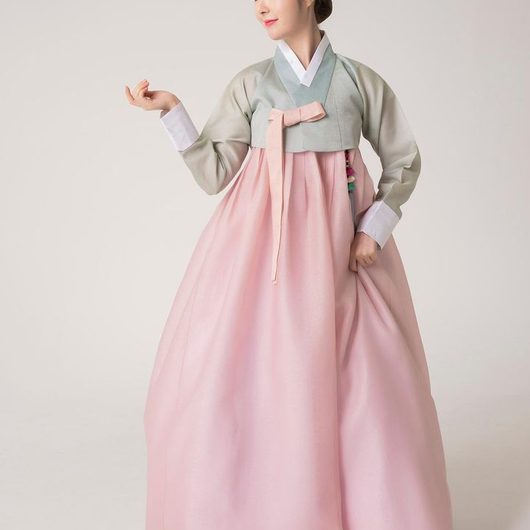
What it is: The Hanbok is the traditional Korean dress, known for its bright colors and simple lines.
Key Characteristics:
- The Top (Jeogori): It is a short, bolero-style jacket. Unlike Hanfu or Kimono, it is typically very short—often just covering the bust.
- The Skirt (Chima): The skirt is high-waisted, extremely wide, and voluminous, resembling a bell shape.
- The Ribbon (Goreum): The Hanbok is tied with a single, long ribbon on the front of the jacket, rather than a thick belt.
- Colors: Hanbok traditionally uses very vibrant, contrasting colors and bold patterns.
The Vibe: It offers a playful, romantic, and highly voluminous silhouette.
Summary: How to Tell Them Apart at a Glance
If you are looking at a picture and trying to guess which is which, look for these three things:
- Look at the waist: Is there a massive, stiff belt tied at the back? It’s a Kimono. Is there a long, thin ribbon tied at the front? It’s a Hanbok. Is it tied with a soft fabric sash? It’s likely a Hanfu.
- Look at the skirt: Does the skirt look like a bell or a balloon? Hanbok. Does it fall straight down like a column? Kimono. Is it pleated and flowing? Hanfu (especially the Ma Mian Qun).
- Look at the top length: If the top jacket is very short (just covering the chest), it’s a Hanbok. If it’s a long robe, it’s a Kimono or Hanfu.
Ready to Experience Hanfu Yourself?
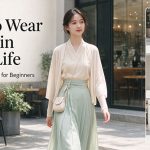
With its flowing skirts, crossed collars, and elegant layers, Hanfu offers a unique and comfortable way to connect with traditional Chinese culture.
If you want to give it a try, you don’t need a full historical ensemble. Starting with a versatile piece, like an elegant Hanfu hairpin or a modern-adapted skirt, is a great first step.
Explore our Best Hanfu picks to find a style that fits your modern wardrobe!
(As an Amazon Associate, we earn from qualifying purchases.)
Leave a Reply
You must be logged in to post a comment.